
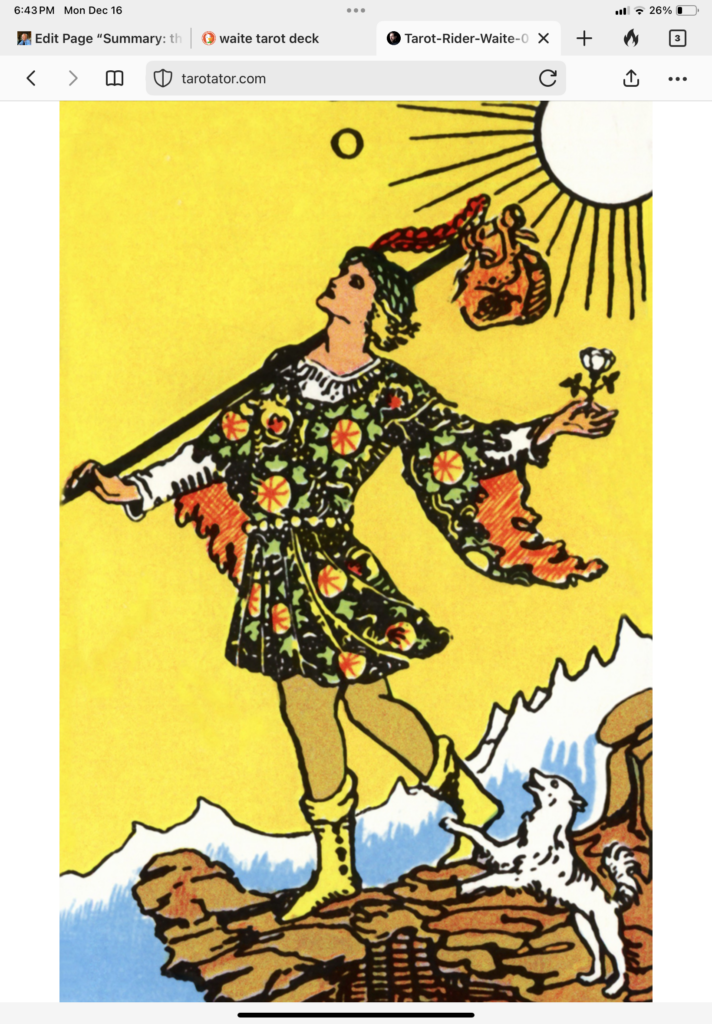
0 – THE FOOL
(Air)
We talk of some people as being “experienced” and others as “inexperienced” — at a certain job or profession, or with respect to life in general. This means: we arrive on the scene with a mind unfamiliar with the nature and structure of things we are going to have to learn to cope with. As we gain experience our minds become formed by the things we deal with, our minds take on the structure of these realities, so that they spontaneously operate in patterns appropriate to what it is that we have to deal with.
There is an advantage to this but also a disadvantage. As our mind becomes more experienced it also becomes more dulled — or possibly, in regard to life, “jaded”. There is a freshness that the beginner brings to a task that tends to disappear as she gains experience — a freshness that makes the job more interesting to her, and also sometimes allows her to see things from a better angle than the veteran. In life the experienced person is often one who has had to compromise, has lost the innocence and natural integrity that the younger person has.
What is it that tends to get lost as we become “experienced”? It is a certain quality of our minds — a quality represented by The Fool.
“The Fool” is chosen to represent this quality because the fool — whether the comedian, the simpleton, or the madman — is one who “doesn’t know the rules” of conventional society. She is one
who “follows a different drummer”, is guided by impulses that don’t run along established social patterns.
The Fool represents an aspect of the mind much esteemed by occultists — who often themselves appear to be foolish and a bit insane from a conventional standpoint. This is an aspect of the mind much cultivated by mystics, prophets, and poets, who prize visions, ideas, and impulses that come from outside the world of ordinary experience. The fool in this sense is an “other-worldly” figure. Compare, for example, the conventional association of the genius and the madman, and St. Paul’s ideas on “divine foolishness” in 1 and 2 Corinthians.j
Part of the Golden Dawn interpretation of the Fool follows from the place they found for this card at the very top of the Tree of Life. The number of the card, zero, is associated with God who in the Kabbala (following Neoplatonism) is completely intangible, undefinable, and unknowable, and is therefore said to
have a “negative existence”.
And the first emanation from God, the first thing he creates as the beginning of the world, is simply a clear ray of light. And it is this light whose shining is human consciousness. This pure light of consciousness then, Mind considered by itself, prior to its involvement with the World and so prior to any particular content it might have — when it is still a negative “zero” — is
thus the next thing to God. (This exaltation of content-less consciousness is found, in a somewhat different context, in Zen Buddhism. It is also the basis for what is now generally called “apophatic” mysticism in the West.)
All these ideas the Golden Dawn associated with the image of The Fool because, by comparison with those who “know the ways of the world” at least, the fool’s mind is unformed and empty.
On the other side, Golden Dawn teachings also emphasize however that from another perspective
the “foolish” side of the Mind is by itself incomplete. Even though involvement with the World will feel to
the innocent soul like a fall from its pristine purity, there is something lacking in the person who has not
struggled with the “hard facts” of the World. (See the comments on card VI, The Lovers, below.) World
“educates” the soul, not in the intellectual sense, but in the psychological sense of bringing its various
potentialities to realization. The “abstractness” of life unintegrated with the realities of the ordinary world
is represented in the card by the icy mountains in the background. (Notice the same mountains in the
Hermit card, where they have this same meaning.)
Waite’s picture shows a young person setting off on a journey (the soul setting off on the journey of
life), completely innocent and oblivious of any dangers (the cliff in front of him). The white rose and the
white undergarment show his innocence. The white sun over his shoulder is Kether, the unmanifest
“other-world” from which he comes. On his cloak are eight-spoked wheels, and one three-fingered
“shin”, both signs of otherworldly spirit. The rock behind him has a very phallic shape — probably
reflecting the idea that The Fool besides being the highest, beginning stage of the “light” of
consciousness, is also a manifestation of the primal life-energy of Mind, symbolized often in occultism
as masculine sex-energy. (This latter idea is associated especially with Chokmah, sephirah 2 on the
Tree of Life, and may have been introduced into the card because of its place on the Tree running
between 1 [Kether] and 2.) The eagle’s head on The Fool’s wallet is one of the symbols of Scorpio,
which is also especially associated with sex-energy.
The crown of leaves, the feather sticking out of it, and the fool’s wallet is one of the symbols of
Scorpio, which is also especially associated with sex-energy.
The crown of leaves, the feather sticking out of it, and the accompanying dog are usually said to
represent the animal and vegetable worlds — probably an attempt to “balance” the symbolism, to show
that the “spiritual” subjectivity represented by the fool is always found rooted in the material world. There are frequent warnings in Golden Dawn writings about the necessity of “balancing” symbols when they are being used, say, in a talisman or a ritual. That is, symbols are thought to represent and even send out, certain kinds of energy, and it is dangerous to come under the influence of one single kind of energy — this is like for example a “monomaniac”, who has an “unbalanced” mind, driven by a single impulse or idea. In constructing complex symbols such as Tarot cards, then, one should just on principle include some elements which do not belong to the main theme of the card. And in some respects “balancing” the card is best done by including some elements which are the polar opposite to the main theme. (See for example the “solar” cross on the breast of the High Priestess, in a card otherwise dominated by moon-symbolism

Leave a Reply